tree-service
Tree Trimming Cost in New Mexico
Trimming cottonwoods, Siberian elms, and junipers in New Mexico runs about $200 to $700 per tree. Defensible-space work and travel fees change totals.
In This Article
Tree Trimming Cost in New Mexico
New Mexico's trees are a different animal from the oaks and maples that fill national cost guides. The state's yards hold valley cottonwoods with trunks five feet across, Siberian elms that grow like weeds and break like glass, piñons that need almost nothing in a good year, and junipers that turn into torches when they need anything at all.
Each of those species asks for different work, which is why trimming quotes here spread so wide. Most New Mexico homeowners pay somewhere between $200 and $700 per tree, with small junipers at the bottom of the range and giant bosque cottonwoods running $800 to $1,600.
Two local forces push prices around in ways out-of-state cost charts miss. Fire mitigation drives a huge share of the trimming work in the foothills and mountain villages, and long distances between towns mean travel fees are a routine line item across most of the state.
What Each Desert Species Costs to Trim
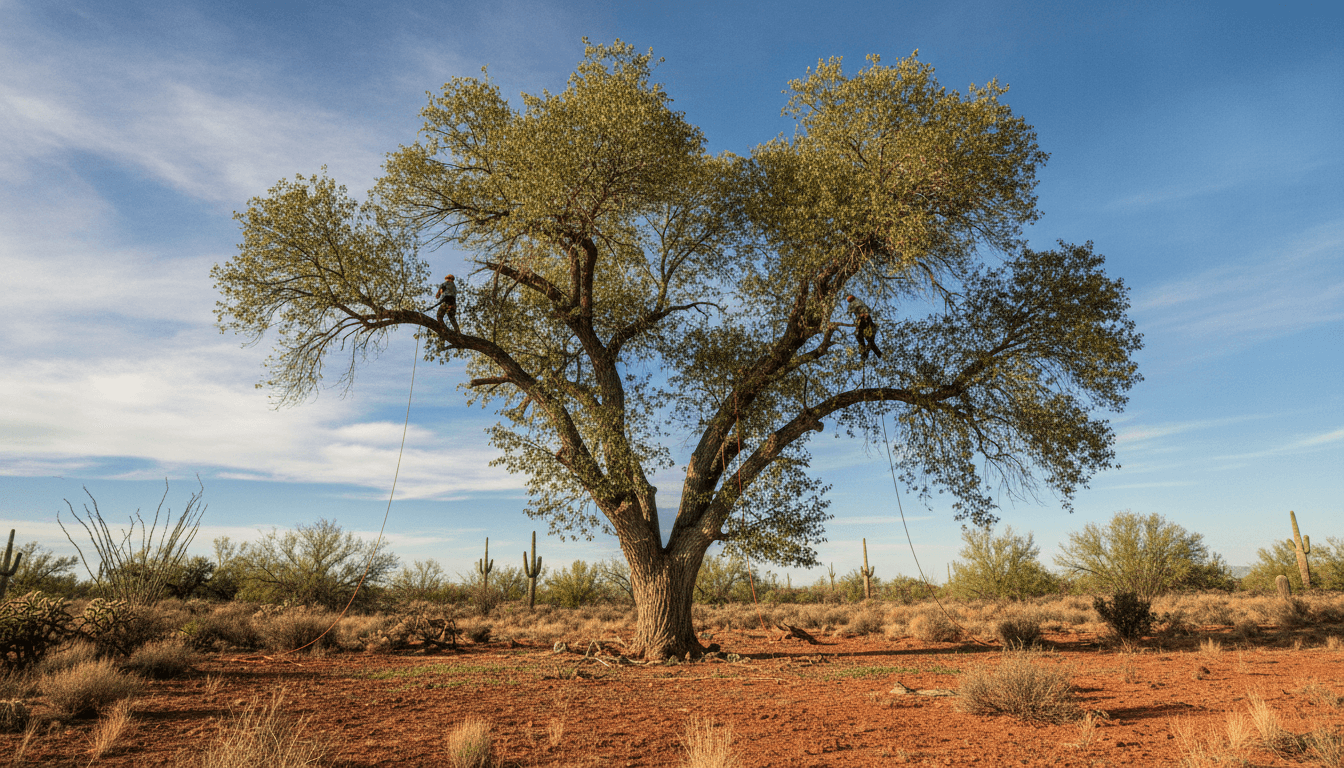
Cottonwoods are the big-ticket item. A mature Rio Grande cottonwood in Albuquerque's North Valley can spread 70 feet, and cleaning the deadwood out of one runs $700 to $1,600 because the soft, heavy wood demands slow rigging.
Siberian elms are the workhorse call for every crew in the state. Planted by the thousands across the decades and now brittle with age, they shed limbs in every spring wind event, and a maintenance trim on a mature one runs $300 to $700.
Piñons and junipers sit at the cheap end, usually $75 to $250 per tree. The work is light: deadwood, clearance from structures, and lower-limb removal, and a crew can often do a whole yard of them in a morning.
Fruit and ornamental trees round out most quotes. Apples in the mountain villages, ash and desert willow in town, and globe willows everywhere run $100 to $350 depending on size and neglect.
Globe willows deserve their own warning label. They grow fast, split at weak forks, and account for a steady share of the storm cleanup calls Albuquerque crews run every spring.
Elevation decides the species mix as much as any nursery choice. Valley floors grow the cottonwood giants, mid-elevations run to elm and ash, and above 6,500 feet the work shifts to ponderosa, fir, and aspen.
One species note saves money statewide. Elms and other fast growers respond to hard cutting with even faster weak regrowth, so paying for a proper thinning every few years beats paying for a cheap topping that doubles the workload next time.
Defensible Space: Fire Mitigation Is Trimming Work
In the foothills of the Sandias, the East Mountains, and the villages from Ruidoso to Los Alamos, most tree trimming is fire work. Crews limb trees up 6 to 10 feet from the ground, open spacing between crowns, and clear ladder fuels like brush and low juniper so a ground fire cannot climb into the canopy.
Defensible-space packages are usually priced by the job rather than the tree. Treating the first 30 feet around a house typically runs $500 to $1,500, and a full acre of thinning can reach $1,500 to $3,500 depending on density and slope.
Junipers deserve special attention in that math. An unpruned juniper against a wall holds years of dead interior growth that ignites from a single ember, which is why mitigation crews either skirt them up or recommend removing the ones touching structures.
Slope multiplies both the fire risk and the price. Fire moves faster uphill, so mitigation standards call for wider spacing on grades, and crews bill more for hauling slash off a hillside than off a flat lot.
Insurance pressure is doing what persuasion never quite managed. More carriers now ask foothill policyholders for photos of cleared defensible space at renewal, and a documented mitigation job pays for itself in a kept policy.
Cost-share help exists in many fire-prone counties. Some New Mexico communities and fire councils offer grants or free assessments for defensible-space work, so ask locally before paying full freight, and expect insurers to keep nudging foothill homeowners toward this work at renewal time.
The calendar matters more with fire work than any other trimming. Crews book solid from March through June as fire season approaches, so the homeowners who schedule mitigation in fall and winter get better prices and a finished buffer before the windy season arrives.
City Prices: Albuquerque, Santa Fe, and Las Cruces
Albuquerque anchors the state's tree market and sets its baseline prices. Standard trims across the metro run $250 to $650, with valley cottonwood work above that, and the depth of competition means three quotes will genuinely differ.
Santa Fe runs 10 to 25 percent higher than Albuquerque for comparable work. Labor costs more, historic-area lots complicate access, and demand from larger properties in the surrounding foothills keeps the better crews booked.
Las Cruces comes in at or below the Albuquerque baseline for most jobs. The Mesilla Valley's pecan orchards shape the local trade, and crews there are unusually good at the aggressive winter pruning pecans need, which for a backyard specimen runs $250 to $600.
Rio Rancho and the East Mountains lean on Albuquerque's crews, usually with a modest trip charge added. Los Alamos and White Rock behave more like Santa Fe, with mitigation demand keeping calendars full into early summer.
Roswell, Farmington, Gallup, and the smaller cities carry lower hourly rates but thinner competition. With only a handful of insured outfits serving some of these areas, quotes can land anywhere, and patience plus a second opinion pays.
Why Rural New Mexico Pays Travel Fees
New Mexico is the fifth-largest state by land area with just over two million people, and most of its licensed, insured tree crews cluster in the Rio Grande corridor. When a crew drives from Albuquerque to a job outside Mountainair or from Las Cruces up to Truth or Consequences, the miles get billed.
Travel fees commonly run $50 to $200 each way, and some companies simply fold them into a higher minimum. A job that would carry a $250 minimum in town might carry a $400 minimum sixty miles out.
Lower competition compounds the distance problem. In much of rural New Mexico only one or two real tree services cover an entire county, and without a competing bid there is little pressure on the number.
Rural homeowners have two good counters. Bundle every tree on the property into one visit so the travel fee spreads across more work, and coordinate with neighbors so the crew books two or three jobs in the same village on the same day.
Scheduling flexibility is worth more in the countryside than in town. A crew that can slot your job into a week when it is already working your area will often waive the trip charge outright.
Getting Solid Quotes in a Thin Market
Insurance verification matters more in New Mexico than in crowded states, because thin markets attract uninsured side operators. Ask for a certificate of liability sent from the agent, and treat a cash-only, no-paperwork offer as the risk it is.
Scope in writing keeps desert jobs honest. A quote should name each tree, what comes off it, and whether hauling is included, since slash and brush disposal is its own chore where landfills are distant.
Photos speed up the whole process in a state this size. Most companies will rough-quote from a handful of pictures with something for scale, then firm the number up on arrival.
The directory lists insured tree service companies by area, which is a faster starting point than cold-calling across county lines. For homeowners weighing trimming against removal or other yard work, the full library of cost guides covers those numbers too.
Water is the last piece of a smart trim in this state. A tree pruned during drought recovers on a schedule set by soil moisture, so deep-water the root zone in the weeks after the crew leaves.
Frequently Asked Questions
How much does it cost to trim a cottonwood in Albuquerque?
Most mature Rio Grande cottonwoods run $700 to $1,600 for a full deadwood and structure trim. Soft wood over houses and acequias makes rigging slow, which is where the cost lives.
What does defensible-space trimming cost in New Mexico?
Treating the first 30 feet around a home typically runs $500 to $1,500, and full-acre thinning can reach $3,500 on dense, sloped lots. Some counties offer cost-share grants that cover part of it.
Why are Siberian elms so expensive to maintain?
They grow several feet a year and the wood breaks easily, so they need attention every 2 to 3 years where a slower tree could wait 5. Proper thinning costs $300 to $700 but lasts longer than cheap topping.
Do tree services charge travel fees in rural New Mexico?
Commonly, yes, at $50 to $200 each way once a job sits 30 or more miles from the crew's base. Bundling trees or scheduling with neighbors spreads that fee across more work.
When is the best time to trim trees in New Mexico?
Late fall through winter for most species, when trees are dormant and fire-mitigation crews have open calendars. Pecans in the Las Cruces area are also winter-pruned, so book those early.