pressure-washing
Can You Pressure Wash Stucco? How to Clean New Mexico Homes Safely
You can wash stucco, but only at low pressure. See how cement stucco, EIFS, and adobe differ, and why soft washing is the standard for New Mexico homes.
In This Article
Can You Pressure Wash Stucco? How to Clean New Mexico Homes Safely
Yes, you can pressure wash stucco, but only at low pressure, and the machine most homeowners rent is set up to do damage. Anything much past 1,000 PSI can etch the finish, blow holes in weak spots, and force water behind the wall where it does its worst work unseen.
The standard approach for stucco in New Mexico is closer to a controlled rinse than a blast. Pros call it soft washing: garden-hose pressures, a cleaning mix that does the lifting, and patience instead of PSI.
Which version of stucco you own changes the rules further. A cement-stucco house in Rio Rancho, NM, a synthetic-clad build from the 2000s, and a real adobe in Corrales, NM tolerate water in three different ways, and treating them the same is how repairs start.
What High Pressure Does to a Stucco Wall
Stucco is a rigid, porous skin, and a zero-degree tip at close range cuts it like a router. The visible damage shows up as gouges, chipped corners, and pale streaks where the pigmented color coat has been stripped down to the brown coat underneath.
The invisible damage costs more. Driven water slips through hairline cracks and open pores, soaks the layers behind the finish, and shows up weeks later as staining, efflorescence, or bubbling paint, long after the machine went back to the rental counter.
Repairs are rarely small because color-matching stucco is hard. Patching a fist-sized blowout means feathering new material into a sun-faded wall, and many homeowners end up recoating a whole elevation to hide one afternoon's mistake.
A good rule for any test: stand back, start at the lowest setting with a wide 40-degree tip, and stop the moment the surface sheds grit. Sand in the runoff means the wall itself is leaving.
Cement Stucco, Synthetic, and Adobe Follow Different Rules
Three wall systems wear the name stucco in this state, and they look alike from the curb. What sits behind the texture is what determines how much washing each one survives.
Age and construction era offer the first clue. Homes built before the 1990s usually carry traditional cement stucco, many builds from the 1990s onward use synthetic systems, and adobe runs from historic Territorial homes to newer custom builds.
An inspection report or the original builder's spec sheet settles the question when you have either one. When you have neither, the tap test described below and a look at an exposed edge near a hose bib usually tell the story.
Traditional Cement Stucco
Cement stucco is the toughest of the three, laid in coats over lath and cured hard. It tolerates a careful low-pressure rinse under roughly 1,000 PSI with a wide tip held a few feet off the wall, which makes it the only version where a pressure washer belongs at all.
Even here, the machine should stay away from cracks, window perimeters, and parapet tops. Those are the entry points, and driving water into them defeats the purpose of cleaning.
Synthetic Stucco, Known as EIFS
EIFS builds a stucco look over foam board and a thin polymer base coat, and the whole system depends on its seams staying sealed. Pressure washing EIFS voids that bargain, since water forced past a seam saturates the foam and the sheathing behind it.
Garden-hose rinsing with a soft-wash mix is the ceiling for EIFS. If you are unsure which system you own, tap the wall: cement stucco sounds like masonry, while EIFS sounds hollow, like knocking on a cooler.
Real Adobe
Adobe is stabilized earth, and mud-plastered adobe should never see pressurized water at any setting. A pressure washer will carve channels in minutes, and even an aggressive hose stream can erode exposed courses.
Cleaning adobe means dry methods first, a soft brush and gentle rinse where the finish allows, and a preservation-minded contractor for anything historic. Owners of older homes in Santa Fe, NM learn to budget for replastering instead of washing.
The Stains New Mexico Puts on a Wall
Spring winds are the biggest culprit statewide. From March into May, blowing dust settles into stucco texture as a dull film, and by June a white or tan house reads several shades darker than its true color.
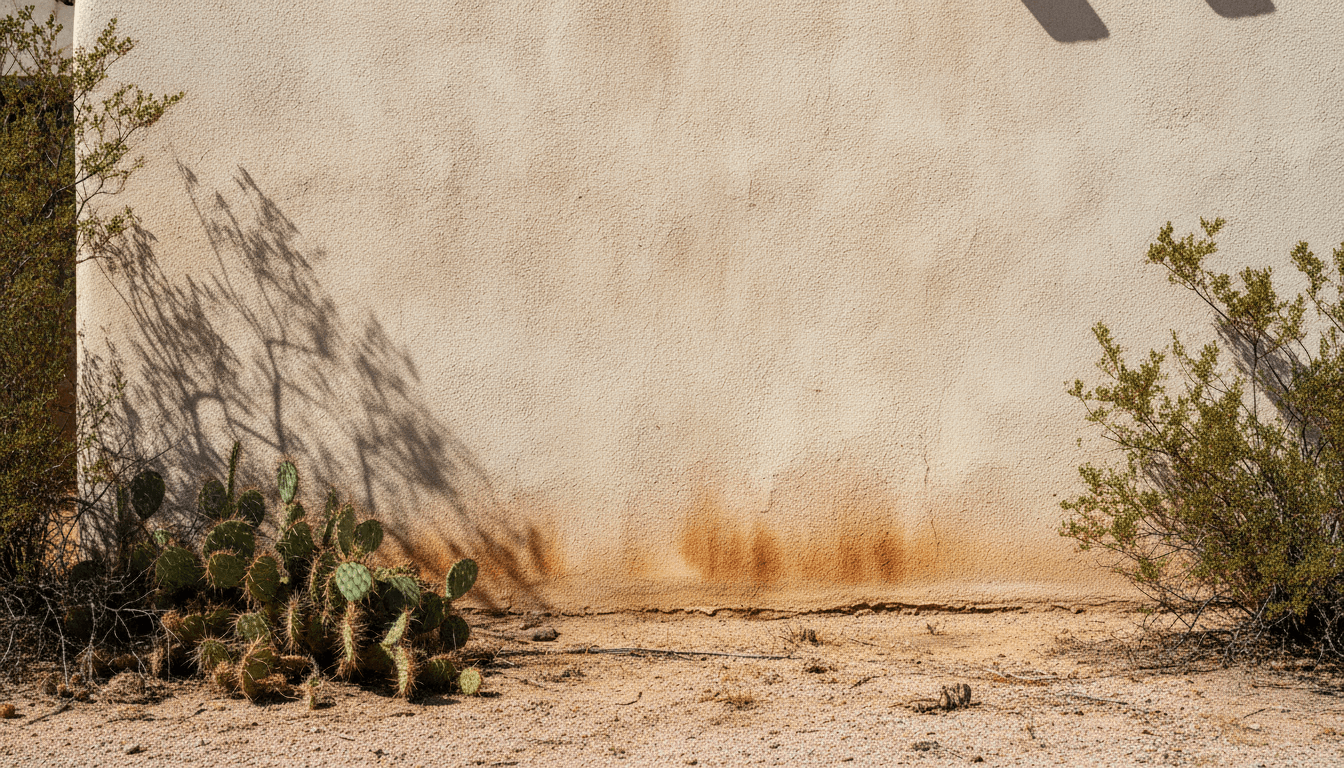
Monsoon season adds the second signature stain. July and August downpours bounce grit off the ground and onto the wall, leaving a brown splash-back band along the foundation line that rarely rises more than two feet.
Flat-roofed homes collect a third kind. On Pueblo-style houses in Albuquerque, NM and Santa Fe, NM, water exits through canales, and every storm leaves dark vertical streaks down the parapet and wall below each spout, with mineral crust where the water dries.
The desert's temperature swings do quiet damage on their own. Thirty-degree drops between afternoon and midnight work hairline cracks into the finish year after year, which is exactly why forcing water at a stucco wall is riskier here than in gentler climates.
Those cracks deserve a walk-around before any washing happens. Sealing gaps wider than a credit card edge with a paintable stucco caulk first means the cleaning day adds shine instead of moisture problems.
How Soft Washing Gets It Clean
Soft washing runs the process in the order high pressure skips: wet, treat, wait, rinse. The wall gets pre-wet at garden-hose pressure, a diluted house-wash mix goes on from a pump sprayer, the chemistry sits for five to ten minutes without drying, and everything rinses off top to bottom.
The mix does not need to be exotic. A standard house-wash blend of mild detergent with a small proportion of sodium hypochlorite handles organic staining, while plain dust film often surrenders to detergent alone.
Equipment stays simple too. A two-gallon pump sprayer, a soft-bristle brush on a pole for stubborn spots, and a hose with a fan nozzle cover the whole job, which is why a first-time soft wash costs under $50 in supplies.
Work one wall at a time, in shade if possible, because the mix cannot be allowed to dry on hot stucco. Midsummer in Albuquerque, NM, that means washing the west wall in the morning and the east wall after lunch.
Protect what the wall touches. Wet down plants along the foundation before and after, cover fixtures and outlets, and keep the stream out of weep screeds, vents, and the gap under window sills.
Canale streaks and splash-back bands may need a second round with the mix a little stronger. Mineral crusting that survives two treatments is a repaint conversation, since scrubbing harder trades a stain for a bare spot.
When to Call a Pro and What It Costs
Professional soft washing for a single-story stucco home in New Mexico typically runs $250 to $600, with two-story homes reaching $400 to $800 depending on size and access. Companies price by square footage, stain severity, and how much masking the job needs.
Certain jobs should go straight to a pro. Adobe of any age, EIFS with visible seam gaps, walls with widespread cracking, and any home where staining hints at a drainage problem all deserve experienced eyes before water gets involved.
Two-story homes tip the math toward hiring out as well. Running a sprayer and brush from a ladder is slow, awkward work, and a crew with the right wands finishes in two hours what a homeowner spends a weekend on.
Interview for method, since plenty of outfits still lead with PSI. Asking how they handle pressure washing on stucco surfaces will sort them fast, and the right answer mentions low pressure, dwell time, and rinsing rather than horsepower.
Once a year is plenty for most homes, timed after the spring winds die down or after monsoon season closes. Between washes, hosing the splash-back zone a few times a season keeps the foundation line from building a stain that needs chemistry to remove. Seasonal maintenance guides in the rest of our home care library cover what else the monsoon months demand from a house here.
Frequently Asked Questions
What PSI is safe for stucco?
Stay under roughly 1,000 PSI with a wide 40-degree tip, and only on sound cement stucco. Synthetic systems and adobe should never see machine pressure, and a garden hose runs around 50 to 60 PSI, which is the true working range for soft washing.
Can you pressure wash adobe?
No, at any setting. Pressurized water erodes stabilized earth and mud plaster in minutes, so adobe gets dry brushing, the gentlest possible rinse, and professional replastering when stains run deep. Historic districts in Santa Fe, NM often have preservation guidelines that apply too.
How often should stucco be washed in New Mexico?
Once a year suits most homes, scheduled in early June after spring winds or in October after the monsoon. Homes on dirt roads or near active construction may want a light rinse each season instead.
What removes the dark streaks under canales?
A soft-wash mix with a longer dwell time takes off the organic portion, and a follow-up with a mild masonry-safe cleaner addresses mineral deposits. Streaks that return within weeks usually mean the canale needs a splash guard or an extension, and that fix costs less than repeated washing.
Is soft washing safe for painted or elastomeric coatings?
Yes, when the mix is diluted properly and rinsed thoroughly. Elastomeric coatings common on New Mexico homes tolerate detergent well but can bubble under high pressure, one more reason the machine stays on its lowest setting or in the garage.